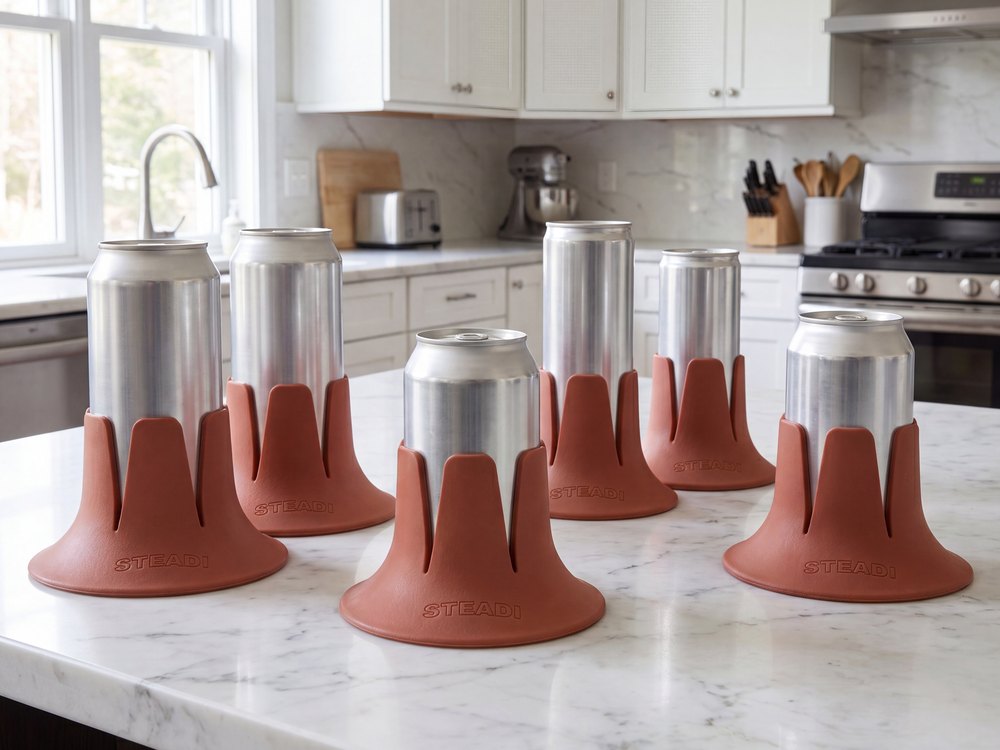
—A base for the middle of the boat
The hardware is excellent and nearly free. Fisheries Supply lists Attwood’s recessed holder at $2.40. What it asks of you is a 3-inch hole in your boat, with three unobstructed inches of nothing behind it, and a drain run somewhere sensible.
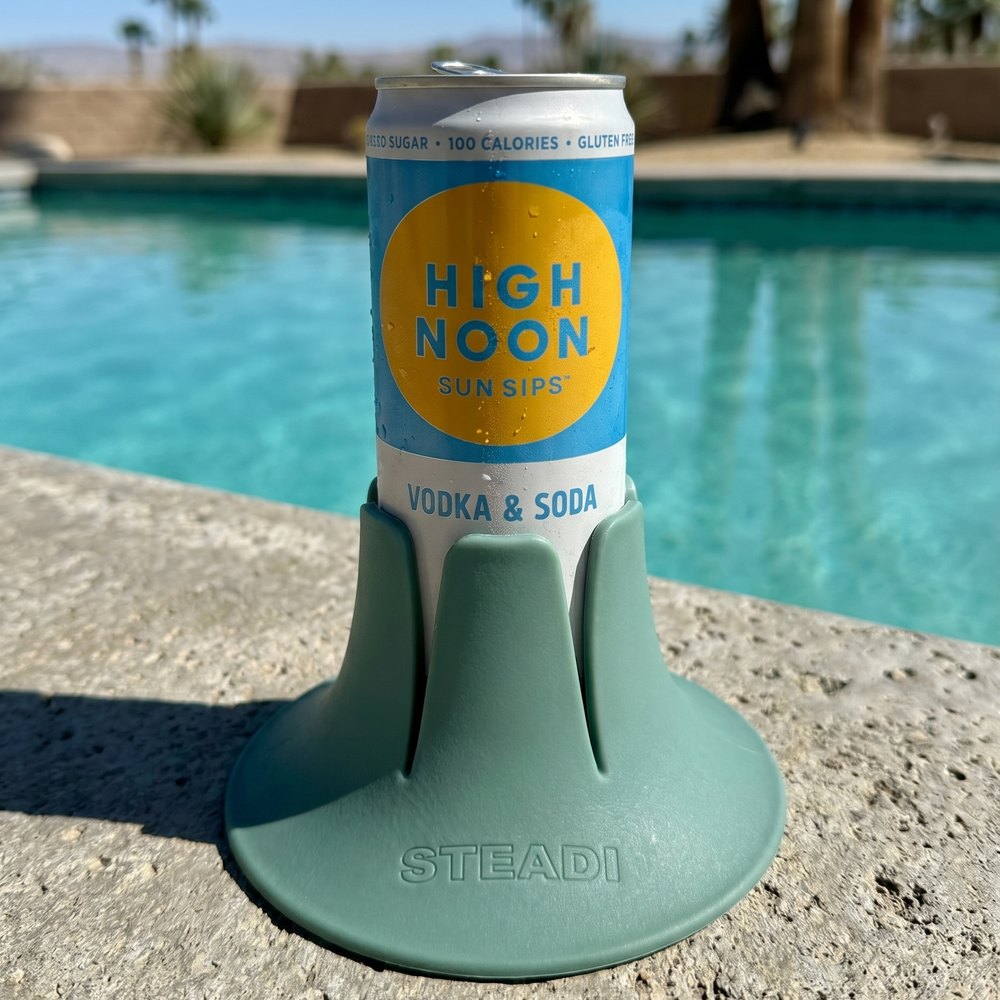
Your console has that. Your gunwale cap has that. The bow cushion, the sun pad, the cooler lid and the seat you are actually sitting in never had it and never will. This is a 5.2″ moulded base that stands on them instead.
122 reviews · 4.9 average · 98 verified purchases
See the packsfrom $14.95 · free shipping on every order
Ships from Orange, California. 90 days to change your mind, used is fine.
Steadi Labs LLC — Scott Rodriguez, founder. Veteran founded.
3419 E Chapman Ave #411, Orange, California · hello@steadilabs.com
“First time I have ever ordered from Facebook feed. Very easy. Happy with product.”Steve Butler · 8 August 2026
—Read this before anything else
When Practical Sailor compared drink holders, it sorted the whole field into four groups and named every group after what the holder grabs: lifeline-mounted, rail- and pulpit-mounted, binnacle-mounted, bulkhead-mounted. Not one category was named after a drink. Every one was named after a piece of the boat.
Attwood’s 2025 catalogue says the same thing in product form. Look past the photographs to the mounting method and there are only ever four of them.
3″ hole
cut it, drain it
Sunk into a moulding, self-draining. Sea-Dog’s standard flush mounts take containers up to 2-7/8″ and want a 3″ hole; the larger one wants 3-3/4″.
bracket
a flat vertical face
A self-levelling holder on a surface-mounting bracket. Attwood’s moulded version is the one with a slot for a coffee cup handle.
4 × #10
something to screw into
Surface mounted through four #10 screw holes, folded flat when nobody is drinking. Same requirement as the LED stainless line.
$14.95
no hole required
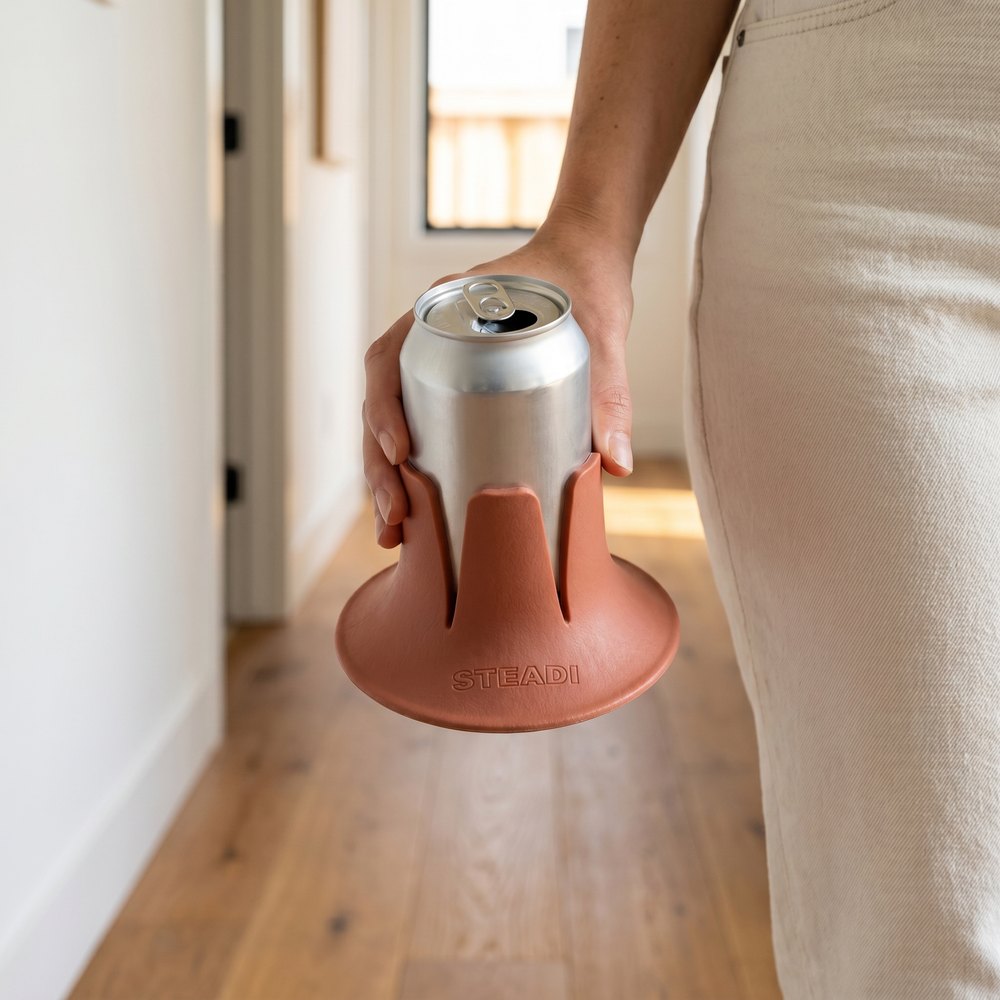
A 5.2″ moulded base, about 3.6 ounces, that the drink stands in. It lifts straight off and goes to the next seat.
That is the entire menu, and every item on it is a way of fastening a cup to the boat. Which is fine — right up until you notice who has to supply the fastening point. You do. And the parts of a boat people actually sit in supply nothing.
It is not a stinginess problem either. Walstrom Marine’s listing for the 2026 Sea Ray SPX 210 shows nine stainless cup holders in the cockpit, and BoatTEST puts that boat’s person capacity at twelve. Sun Tracker’s Party Barge 20 DLX, rated for ten people, lists drink holders at the console, in the bow port couch armrest, and in the storage area — and then, for the open middle of the deck, lists a removable table with four moulded-in drink holders. That is the industry conceding the point in its own spec sheet. When the builder needed holders where people actually sit, the answer was not hardware. It was furniture you pick up and move.
Sources: practical-sailor.com · docs.navico.com (2025 Attwood catalogue, p.148) · sea-dog.com · walstrom.com · boattest.com · suntrackerboats.com. Fetched 4 September 2026.
—The part nobody quotes you for
White’s Marine lists a stainless recessed unit at 4-3/8″ OD by 3-3/4″ deep, fitting a 3-3/4″ hole, with a fitting for a 3/8″ drain hose. Attwood’s large recessed holder is 3-1/8″ deep. Sea-Dog’s shallow option still wants two inches.
Behind the gunwale liner on a runabout: wiring looms, rigging tubes, sometimes rod storage. Behind a pontoon fence panel: air, and a thin sheet with nothing under it but water. Under a bow cushion: the storage locker, which is the reason the cushion lifts. Behind the transom bench: engine well, battery, fuel tank.
BoatTEST reports that on the Sea Ray SPX 210 the drink holders have drain hoses leading into the bilge to clear away condensation. An undrained holder in an open boat is a rain gauge, and then it sits full for three weeks in the slip.
James G. Merritt, a SAMS Accredited Marine Surveyor with more than a thousand surveys behind him, writes that a moisture meter earns its keep locating penetration around through-hull fittings and deck hardware, and names innocent-looking self-tapping screws as a way in.
Be precise about how bad that is, because the internet oversells it. Merritt also notes that balsa core can be saturated and still not have an appreciable loss of strength. A wet spot is not a totalled boat. It is a maintenance item, a line on a survey, and a conversation with a buyer you would rather skip.
But doing it properly is not one step. The accepted method for a hole through a cored laminate is to over-drill, dig the core out from between the skins with a rotary tool, tape the underside, inject unthickened epoxy so it soaks in, follow with thickened epoxy, cure, then re-drill through solid epoxy.
That is a Saturday, with the boat dry. Which is exactly why the holder that eventually does get added is the one added badly.
The builder already knew all of this. Your holders sit at the helm and along the sides not because a designer decided that is where you would want a drink, but because a console is hollow, a gunwale cap is hollow and an armrest is hollow. That is where a three-inch bucket had somewhere to hang. The real geometry of your boat is a ring of hardware around the outside, and then a middle — bow lounge, sun pad, swim-platform bench, the cooler everybody sits on when the boat is stopped — that will never have hardware in it, at any price.
Sources: shopwms.com · sea-dog.com · boattest.com · marinesurveyor.com (James G. Merritt, SAMS Accredited Marine Surveyor) · marinehowto.com. Fetched 4 September 2026.
—Does it actually work
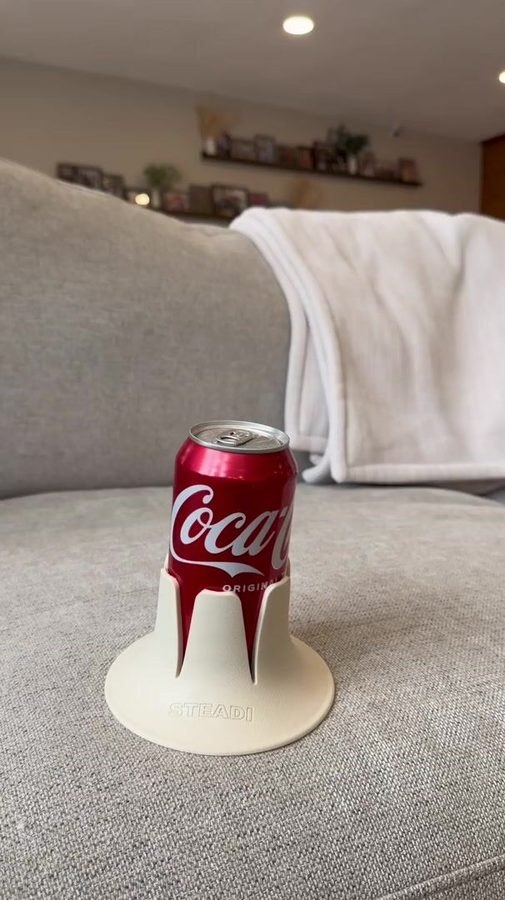
A full can, and somebody sitting down beside it. The base is 5.2 inches across, so the drink has to lean a long way before its weight clears the edge of what is holding it up. That is the whole difference between this and balancing a can on its own bottom.
Filmed on a couch cushion — indoors, not on a boat and not on the water. It is the honest test we have, and a cushion is at least the right kind of surface: soft, uneven, the harder case rather than the flattering one. What it does not show is a boat underway, because nothing loose stays put underway. That limit is written out in full below.
—Why a footprint works where a pocket cannot
A pocket puts the cup inside the boat’s structure and lets the structure do the work. That is genuinely the better mechanism — when the boat has somewhere to put a pocket. Most of the boat does not.
This has no pocket and no structure. It puts 5.2 inches of footprint under a container whose own bottom is somewhere between two and a half and three inches, so the drink’s centre of mass has to travel much further sideways before it clears the edge of its own support. Tipping takes a bigger tilt than it does off a bare cup bottom.
The 5.2 inches are fixed. It does not expand, contract or adjust, and that fixed number is the mechanism.
The tack of the thermoplastic is the other half. It resists sliding on a sun-warmed vinyl cushion or a slick, wet cooler lid, which is exactly where a bare cup bottom goes first.
So: it resists tipping by widening the support under the drink. It is not spill-proof — nothing is, and a knee, an elbow or the cooler lid coming up underneath it still wins.
—The object
Fixed. There is one size and it does not vary.
Low enough that a tumbler’s handle, which sits near the top, passes clear of it.
That range is the whole fit story, and it is the number to check your own drink against.
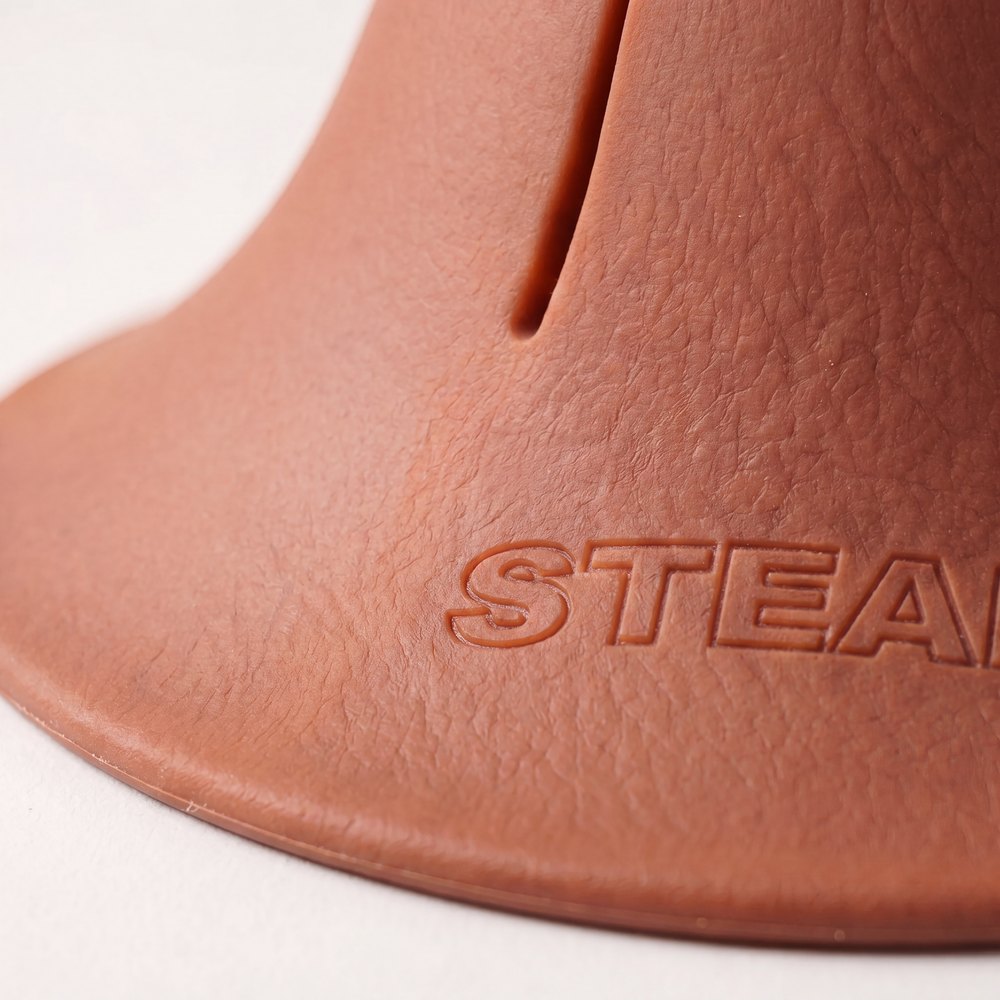
One piece. No hardware, no fasteners, no hinge, nothing to lose over the side in pieces. 100% BPA free.
It does not float, and there is no version of it that does. Treat it like a phone.
—What seats and what does not
“Up to 2-7/8″ in diameter” is Sea-Dog’s published figure for its standard flush mounts, and it is a decision somebody made a long time ago about what a drink is: a 12-ounce can, a bottle, a plastic cup from the marina bar. Your truck quietly fixed that, because truck holders are moulded plastic and tooling gets revised. Your boat cannot. A boat cup holder is a hole cut once into a hull that will still be afloat in twenty years.
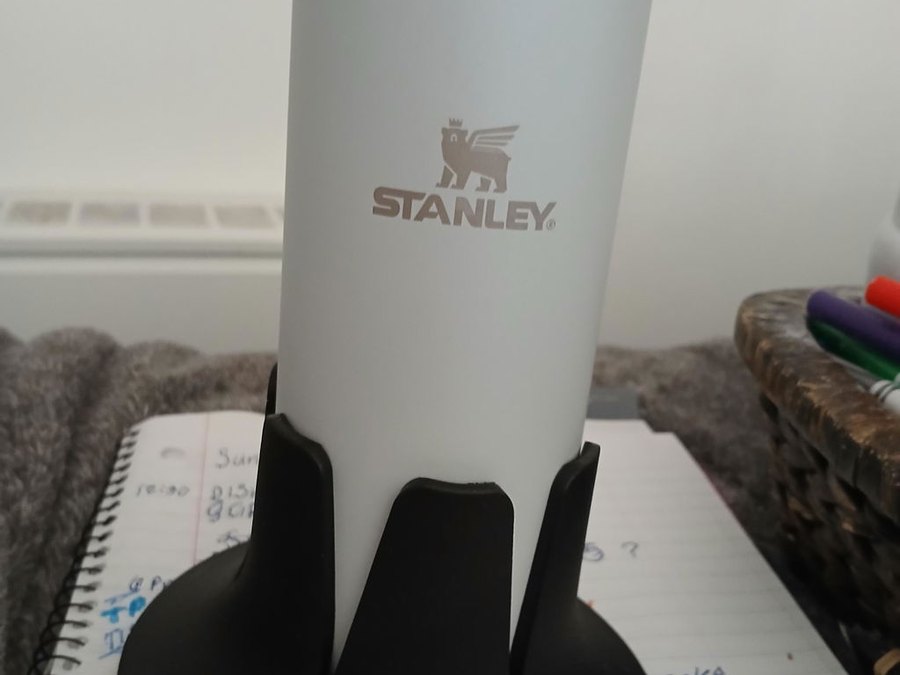
Then the tumbler happened. The Boundary Waters Catalog lists the YETI Rambler 30 oz at 4″ × 7-7/8″ × 2-3/4″ — that 2-3/4″ base settles into the fins here, and it stands nearly eight inches out of a pocket three inches deep. Stanley’s own listing for the 40 oz Quencher H2.0 gives 5.82 × 3.93 × 10.78 inches; its base is published at 3.1″, which seats snug.
Handled mugs and stemmed glasses do not seat. The handle on a mug lands down at the bottom, exactly where the fins grip, and a stem has nothing to grip at all. That is a straight no. A tumbler handle is a different case — it sits near the top, well clear of a 2.8-inch base — but a mug is a mug, and the box below will tell you so too.
Every width below comes from a published specification, not from us. Where a spec is uncertain, the answer says so.
A width across the bottom of the cup, in inches.
A standard sticky note is three inches square. Stand the cup or tumbler on one. If its base sits inside the paper, it will seat.
Anything that overhangs, or anything borderline — hello@steadilabs.com reaches a person, and the answer will be honest either way, including a no.
—Where it goes, and when
The cooler lid. The bow cushion. The sun pad. The transom bench. The swim platform. The dash. The seat beside you, twelve feet from the two holders at the helm that nobody is sitting near. Those are the surfaces a builder was never going to put hardware into at any price, because there is nothing behind them to hang a bucket on.
And the moment matters as much as the surface: rafted up at the sandbar. Anchored in the cove. Tied at the dock. Drifting while the kids swim. On the trailer with the tailgate down. That is not a small window — on most boats, on most days, that is most of the day.
Then stow it before you come onto plane, the same as the towel and the phone. That is not a caveat buried in a footnote; it is how the thing is meant to be used.
Twelve colours, one per unit, which is the fastest way to stop six people arguing about whose can is whose at the sandbar.
—What the aisle actually asks of your boat
Prices and requirements were looked up on 4 September 2026, not estimated. Every figure in the last column is the seller’s or publisher’s own published requirement, and the last row is ours.
| The product | Price | What it asks of the boat |
|---|---|---|
| Recessed plastic holder (Attwood 11789-1, at Fisheries Supply) | $2.40 | A 3-3/4″ cutout and 3-1/8″ of clear space behind it, in a moulding you are willing to cut. Plus the epoxy and the drain. |
| Recessed stainless holder (at White’s Marine) | $22.46 | The same 3-3/4″ hole, 3-3/4″ deep, plus a 3/8″ drain hose run to somewhere that is not your bilge carpet. |
| Clamp-on rail mount (RAILBLAZA, at Boat Outfitters) | $27.00 | A 28 mm or 32 mm square pontoon rail. Camco’s clamp-on suits 3/4″ to 1-1/4″ rails. Screwed together, no drilling — but you must have a rail where people sit. |
| Suction mount (SeaSucker Fisherman’s Cup Holder; E-Sea Company range) | $79.00 E-Sea $31–$55 | A smooth, non-porous surface. SeaSucker’s own FAQ rules out diamond-cut non-skid and warns that pronounced texture makes a vacuum hard to hold. It is a mount you maintain, not one you install. |
| The Marine Cup Holder | $14.95 · four for $39.95, $9.99 each | A flat-ish surface under the whole 5.2″ foot, and a boat that is stopped. Nothing is cut, nothing is clamped, nothing is maintained. |
Three concessions, and all three cost us the sale.
If you have a rail, buy the clamp. A pontoon fence runs the whole way round, which is why pontoons are so well served; on anything else a T-top leg, ski pylon, grab rail or bimini frame is the same opportunity. A rail clamp is fastened to the boat in every way that matters and costs less than lunch. Measure first — SnapIt, who sell them, warn that pontoon rails vary and that you must measure your specific boat.
If your boat gives you smooth gloss, suction is real. SeaSucker’s 4.5″ vacuum mounts are rated at 120 lbs of pull straight out from centre, and that is a serious mount. Docktail, who sell caddies on those mounts, put the requirement flatly: the surface must be smooth. E-Sea sells stick-on discs precisely because a smooth spot is not guaranteed.
And it is not the cheapest option. The Attwood recessed holder is $2.40 if you are willing to cut. What you are paying us for at $14.95 is the hole you did not cut.
There is an irony sitting in the middle of that list. Non-skid texture — the moulded diamond, dot or pyramid pattern — is on your deck on purpose, to keep people upright when it is wet. The surfaces most engineered for safety are the ones a vacuum cup cannot seal to.
What is left over is a specific case, and it is the only one we are claiming: the middle of the boat, no rail within reach of where people sit, a textured or upholstered surface, and a boat that is stopped.
Sources: fisheriessupply.com · shopwms.com · boatoutfitters.com · camcodealer.com · seasucker.com · docktailbar.com · eseaco.com · snapitproducts.com · sea-dog.com · practical-sailor.com · boattest.com · walstrom.com · suntrackerboats.com · marinesurveyor.com · marinehowto.com · boundarywaterscatalog.com · stanley1913.com. Prices and specifications fetched 4 September 2026 and current as of that date. Steadi Labs is not affiliated with any of them.

—Get one
Most people take the two-pack. If the number you are actually feeding is the crew rather than the driver, the four-pack is $39.95, which is $9.99 each. Free shipping on all of them, and 90 days to find out on your own boat.
Checkout is handled by Steadi Labs — the company that makes The Marine Cup Holder. Secure checkout at steadilabs.com. Free shipping on every order, and 90 days to change your mind, used is fine.
—From people who bought one
Verbatim and unedited. This is a slice of one product-wide corpus — reviews of the Steadi, not of this page. Two of the four below do come from boats, which is more than most pages like this can say and still a long way short of proof. The third is a four-star, and it is here because of what it says rather than in spite of it.

★★★★★
Excellent. Fits my small Stanley water bottle perfectly. Highly recommended
Connie Waters · June 2026 — a fit report, which is what this corpus is best atPhoto from the buyerPhoto from the buyerPhoto from the buyerPhoto from the buyerPhoto from the buyerPhoto from the buyerPhoto from the buyer
★★★★★
My friends love the Steadis. Their motorboat had no place for drinks, and no flat surfaces!
Thea Martin · June 2026 — a motorboat, and the exact complaint this page is about
★★★★★
Brilliant idea. These are great on the boat!! Hold up nicely in the wind when my can is almost empty.
Wendy Corlett · May 2026 — a boat, and wind. She does not say the boat was under way, and neither will we
★★★★☆
not as steady as I would like but it is working just fine. It does slide a little. Overall it was a good purchase.
Randee Kirschbrown · August 2026 — the honest one, left in
Sent in with their reviews. Tap any one to read it. Different rooms, different drinks, different colours — none of them staged by us. Some of these buyers were offered a small store credit for sending a photo; nothing was offered for what the review said, and none of them were shown to us before they posted.
There is a fifth review in that corpus from a boat, and we are leaving it off. It says a Steadi prevented many spills
and that they can leave drinks out without worrying. We do not make that claim, and we are not going to let a customer make it for us on a page about a boat.
—Read this before you buy, including the parts that cost us the sale
In Practical Sailor’s comparison test a lifeline-mounted holder jumped ship during a seatrial when its plastic hook came loose, and another’s basket came adrift from its bracket any time it was bumped. Those were fastened products. So anything that merely sits on a surface belongs to a boat that is stopped: anchored, rafted up, tied at the dock, on the trailer. Stow it before you come onto plane, the same as everything else on the deck. No page should show you a drink riding out a wake and tell you it stays put.
It resists tipping by widening the support under the container. It does not eliminate tipping. A knee, an elbow, a dog, or the cooler lid coming up underneath it all still win.
No clamp, no suction cup, no strap, no adhesive, no screws, no hardware of any kind. It stands on the surface and lifts straight off. That is the trade: nothing to fail, and nothing holding it down either.
The mug handle fouls a fin and a stem has nothing to grip. If your drink has a handle at the bottom, Attwood’s moulded gimballed holder is literally built with a slot for a coffee cup handle — buy that one and screw it down.
It does not float. Keep it inboard and off the gunwale cap over open water, the same way you treat a phone. At $14.95 it is a lot cheaper to lose than the tumbler it was holding, but it is still gone.
A gunwale cap that curves is still a curve with a 5.2-inch foot resting on it. It needs something flat-ish underneath, and a rounded cap is not it.
The recessed Attwood part is $2.40 at Fisheries Supply. If cutting the hole is genuinely not a problem for you, cut the hole — you will end up with a better answer for that spot than this is.
Rinse it down with the rest of the gear at the end of the day. We are not going to publish an exposure figure we have not measured.
Source for the seatrial findings: practical-sailor.com, drink-holder comparison test. Fetched 4 September 2026.
—Ninety days
Ninety days from delivery, used is fine. That is a whole run of Saturdays, which is the only test that settles it — whether the surface you had in mind is flat enough, and whether the drink you actually bring aboard seats in the fins.
If the answer turns out to be a rail clamp, we would honestly rather you bought the rail clamp. Send this back.
—Who makes it
Scott Rodriguez made the first one after a full drink went over on a soft cushion with three kids under three in the house. It was built for a couch, not for a cockpit.
Nobody with a boat asked for this page. It exists because a cooler lid and a bow cushion are the same problem as a couch cushion — a flat-ish surface with nothing to fasten to — and because everything it does not do on the water is written out above rather than left for you to find out at the sandbar.
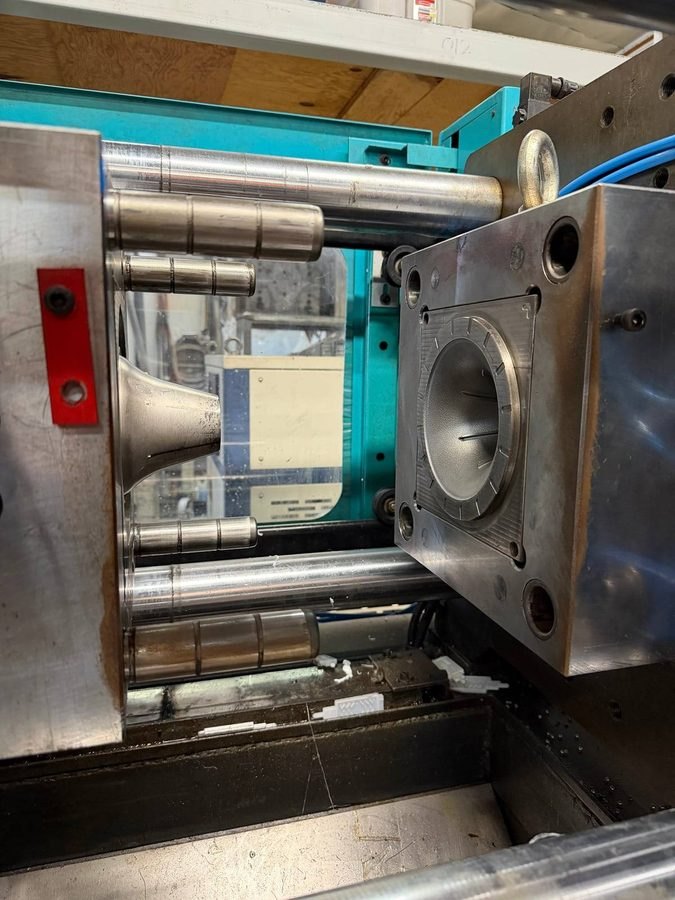
We make one thing and we make all of it here: the moulds, the material, the colour runs, everything within about three and a half miles of the shop.
— Scott, Steadi Labs
—Asked and answered
None of the three. There is no hardware on it at all — it stands on the surface under its own 5.2-inch foot and lifts straight off. That is the whole point of it on a boat where you are not cutting anything, and it is also the reason it can move from the bow cushion to the cooler lid in a second.
Pick it up. Nothing loose stays put underway, and a page that tells you otherwise is selling you something. Even fastened holders have come adrift in published seatrials. This is for anchored, rafted up, beached, docked or on the trailer.
No. It sinks. Keep it inboard, off the gunwale cap, and away from the edge of the swim platform.
The 40 oz Quencher H2.0 is published at a 3.1″ base and seats snug; the 30 oz is published at 3.15″, which is the very top of the fin range and worth checking on a sticky note first. Its handle is near the top and passes clear of a 2.8-inch base. A mug handle, down at the bottom, does not.
No, and you should not want it to. A recessed self-draining holder in a moulding is better than this at the spot where it already exists. This is for the seats the builder could not reach.
Only if yours is flat across the top. Many are crowned, and a 5.2-inch foot on a curve is resting on a line rather than a circle. Also: that is the one place on the boat where a knock puts it over the side, and it does not float.
Rinse it with the rest of the gear. It is one piece of Shore 85A thermoplastic polyurethane with no fasteners, no fabric and no coating to fail. We have not run an exposure test with a number on the end of it, so we are not going to quote you one.
Yes, top rack.
—Still deciding
The part is $2.40 and the hole is a Saturday with epoxy in it, or a dealer’s invoice. That trade is worth making for the console and the gunwale, where the hardware belongs and where there is something behind the moulding to hang it on. It has never once been worth making for a cooler lid.
So: if there is a rail within reach of where people actually sit, buy the clamp. If your deck is smooth gloss, suction is real. If neither is true — and on a bow lounge, a sun pad or a cooler lid neither is ever true — this is $14.95, it moves seat to seat in a second, and there is nothing to undo if you change your mind.
The hardware was never the problem — it is two dollars and it is good. The problem is that half of a boat is a surface with nothing behind it, and a hole cut in 2012 is still a 2012-sized hole. Nobody is adding drink holders to your bow lounge. You just do not have to keep moving your drink every time somebody goes for the next round.
See the packsfrom $14.95 — free shipping on every order
90-day guarantee, used is fine · Made in Orange, California